

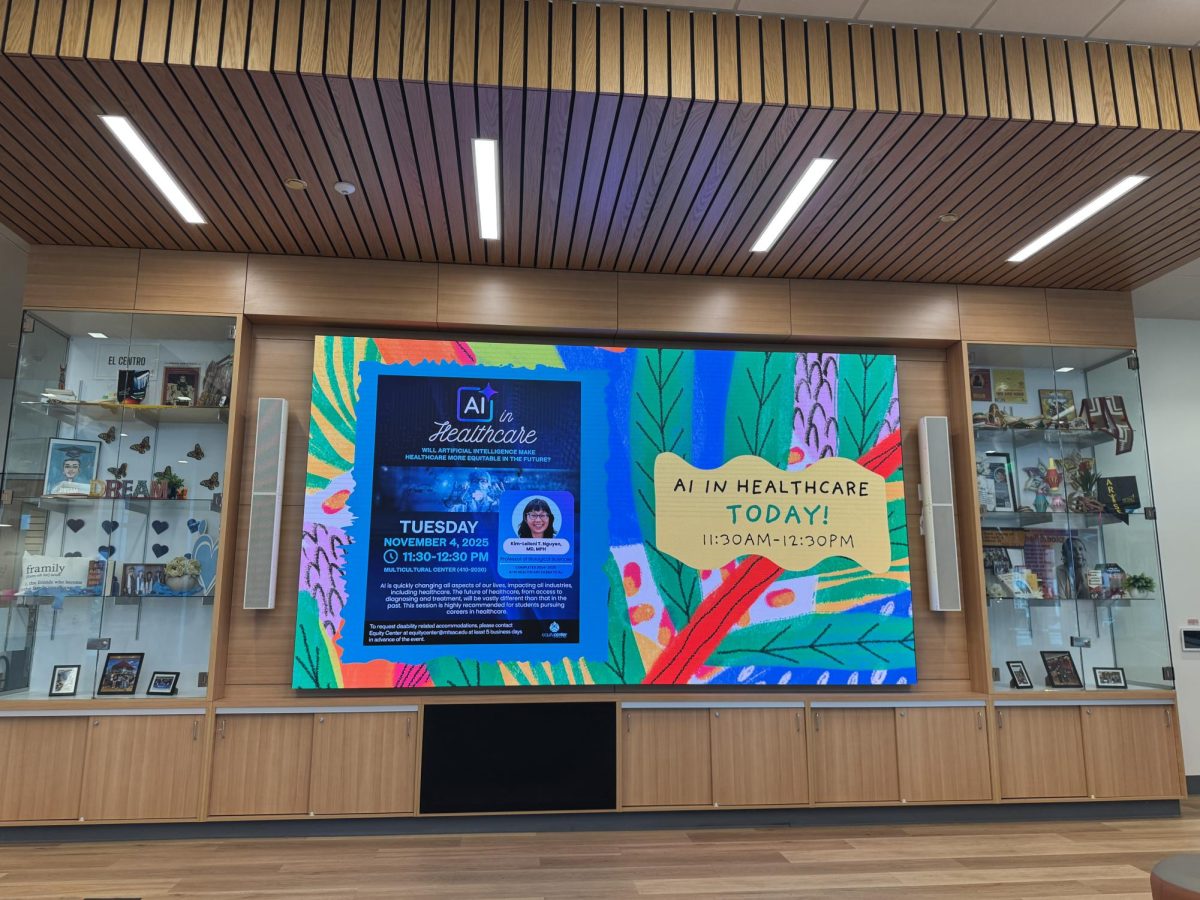
On Nov. 4, the Multicultural Center hosted a workshop to help students who plan to enter the healthcare field prepare and understand how AI will alter the landscape of careers and work in the healthcare field, and how these changes impact equity.
Presented by Dr. Kim-Leiloni T. Nguyen, who just finished a year long sabbatical on AI’s place in the healthcare industry, the workshop painted the picture of assistive, ambient, predictive and agentic AI in the healthcare field. In an interview a few days before the event, Nguyen, who teaches anatomy at Mt. SAC, said of her sabbatical that “AI is going to impact healthcare. Because a lot of the students taking anatomy are pre-healthcare taking the required courses to get into nursing, dental, medicine … AI is a game changer, and I want to know to what extent.”
During her sabbatical, she interviewed current healthcare workers, looked at the training that institutions are offering, talked to laboratory technicians and extensively read published peer-reviewed and unpublished (commonly known as white papers) research on AI’s place in the field.
“I’m trying to come through with a neutral lens,” Nguyen said. “So yes, I point out the goods and then I also point out the bad then I also point out the uglies because there is a lot we don’t know and haven’t answered.”
Along with students, other professors, faculty members and program management were in attendance at the workshop.
Nguyen spent the majority of the event breaking down the difference between assistive, ambient, predictive and agentic AI. She also pointed out the various ways in which patients, doctors, administrative staff and research institutions were using the different types of AI already. Assistive AI aims to assist participants in healthcare by more easily renewing prescriptions, analyzing medical images and data, such as x-ray’s and ECG’s, to completing coding and paperwork. Ambient AI works similarly to a real time assistant, helping with real time transcriptions and real time monitoring of patients. It also can include the use of wearables. Predictive AI helps to manage inventory of sensitive materials, offers diagnoses and supports research. These practices are currently all taking place, and their expansion is prominent. Nguyen pointed out that most of this information was looking backwards, as these things have been happening for some time.
The workshop also explained that agentic AI is AI that interacts with the environment it is in, and this is the type of AI that is looking more into the future. Surgery assistance, companion robots, moving heavier patients, antibacterial microbes that fight infections and robotic nurses are all examples of tangible developments that Nguyen has learned about and that she covered during the workshop.
Attendees felt that the workshop was informational and successful, and left knowing more about AI than before they came.
“The only thing I really knew about was the replacement of scribes and doctors using recording services … Also, a little bit [about] the surgery because my mom had something done similar. But the rest I was not aware of,” Natasha Sanchez, a 36-year-old nursing major, said.
After hearing all of the information in the workshop,“For me, I am [now] trying to figure out how I can integrate this into my teaching,” Christine Yoshida-McMath, an EMT instructor at Mt. SAC said.
While most of the event was focused on the information related to the AI types and developments, equity was addressed during the Q&A toward the end of the event, in which Nguyen addressed questions.
There is still concern “about who is going to be controlling the AI systems, because it might be more equitable, but it depends on who is controlling those systems. Because what if they still use that as a way to reduce access to certain communities, or train AI to be discriminatory in certain ways?” Sanchez said.
When asked about if AI will bring more equity to the healthcare field, “I want to lean more yes than no. Because knowing that we are combining AI with virtual reality, with wearables and with other technology tools, we’re able to bring [healthcare] to more people. And that is equity right there,” Ngyuen said.
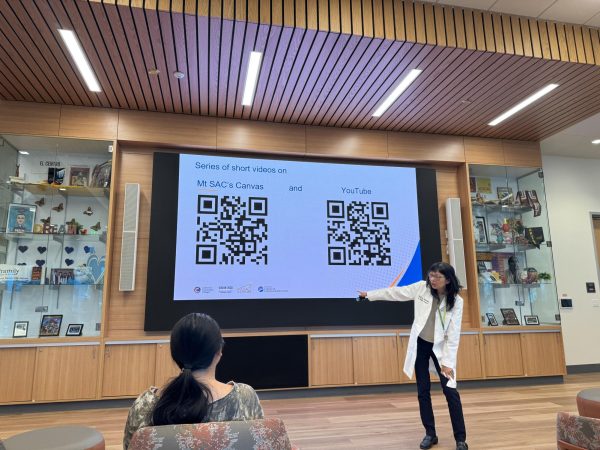
Part of Ngyuen’s sabbatical was to create videos that delve further into the “good, bad, and uglies” related to healthcare and AI, and can be found here.
“It’s not about ‘Oh, do I use AI?’ It’s a matter of how do we use AI to better the outcome of the patient,” Ngyuen said. “AI is here to stay.”
