


“Hoppers” has moments of genius humor, but is ultimately brought down by its weak environmental and political commentary. It fails to remain morally consistent while painting resistance as unethical.
“Hoppers” tells the story of Mabel Tanaka, a college student who dedicates her time to protecting the nearby forest from destruction by the rich Mayor Jerry, who is running for re-election in Beaverton, and wants to build a freeway through a natural glade as part of his campaign.
Not only is the glade emotionally significant to Mabel, but she is also a fierce animal rights advocate. She knows that the environmental damage would harm countless forest creatures.
Eventually, Mabel, through her professor, learns of a way to transfer one’s consciousness into a robot beaver and even speak to animals. Or as the movie so eloquently puts it, “We put this into this, this into this.”
We learn that the animals live in a harmonious, socialist-like paradise and believe that humans also seek peaceful lives. Mabel eventually gets the animals to see that the humans want to keep the land entirely for themselves, regardless of the casualties or the animals’ exploitation. This is where the story takes a drastic turn as the animals plot to kill Jerry.
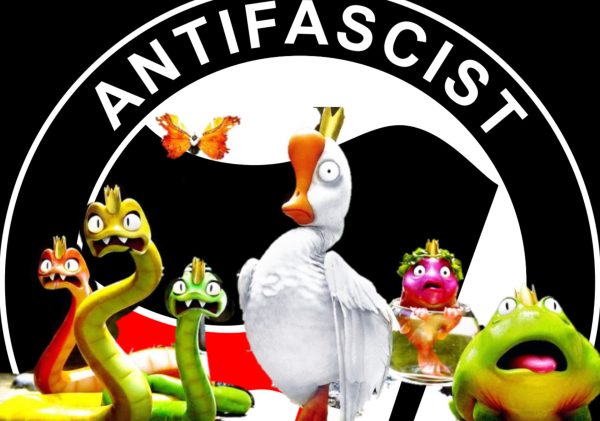
The rest of the movie portrays the animals as genocidal radicals that seek to kill all humans for their previous transgressions against animal kind, so they hatch a plan to kill a large group of humans gathered at a music festival. This is where my issues with the movie start to flare up.
Up to this point, the movie has portrayed the animals as conscious beings with families, laws and feelings that resemble our own lives. So the animals in this case are only acting out of self-preservation against a brutal occupying force. The film paints both parties as morally equivalent, even though the humans are the aggressors.
The climax sees Mabel and Jerry working together to thwart the animals’ plans and the film concludes with them agreeing to resolve each other’s dilemma simply by talking it over. Mabel saves the forest, and Jerry builds the bridge elsewhere; everyone gets exactly what they want without having to sacrifice or compromise.
In a movie with flying sharks and talking beavers, the most outlandish aspect is that the solution to our issues is to just talk things out. It comes off as tone-deaf to present such a milquetoast message in a time where we face unprecedented levels of financial and social injustice that are being committed by the same oligarchs that Mayor Jerry is supposed to represent. While I agree that there is absolutely a problem with political violence in this world, it is morally unconscionable to portray the animals’ resistance as wrong.
Don’t get me wrong, I wish we were in a position where we could just talk things out with the oligarch class, but that is naive. When individuals are subjected to extreme structural violence, we should not be surprised that they answer back with violence. It’s why Luigi Mangione was so popular with younger people, because they’ve grown up being told that the violence being inflicted on them is acceptable. As Martin Luther King Jr said on violent riots, “A riot is the language of the unheard.”
Not to mention that the movie’s events somewhat parallel the events between Israel and Gaza, it is also important to keep in mind that the Disney family’s investment arm, Shamrock Holdings, owns major stakes in Israeli companies. Including real estate firms involved in large-scale projects across Israel. Some of these developments are tied to settlements on occupied Palestinian land.
By now, you must be thinking, “Lucy, it’s just a kids’ movie about talking animals.” While yes, that’s true, it’s still not an appropriate excuse when politically charged kids’ movies already exist. Some of which were even created by Pixar themselves, like “WALL-E.”
I’m not expecting a Pixar film to bust out the Communist Manifesto, but a better message would have been to show that the working class has more bargaining power than they think. Maybe something like the beavers going on strike and stopping dam maintenance causes the city to flood? Instead, the movie presents the communist like beaver society as savage and uncomfortable.
People are allowed to feel whatever way they like about any given political ideology, but the undeniable fact is that a group of people can only endure so much acceptable violence before it explodes. It’s always the offending party’s responsibility to make things right.
For a contrasting view, read Iris España’s review of “Hoppers.”